Author: Andre Nonso
Modern search habits are changing. Instead of typing a query into Google and scrolling through pages of links, many people now rely on AI assistants like ChatGPT, Bing Chat, Google’s AI mode, Perplexity and others to get direct answers. A study by Semrush and Statista found that 13 million U.S. adults used generative‑AI search in 2023, rising to an estimated 90 million by 2027.
Also, Gartner predicted that traditional search engine volume will decline by 25 % by 2026 as users shift to AI chatbots and virtual agents. In other words, the “front page of the internet” is increasingly a synthesised response generated by a large language model. For professional service firms that depend on online visibility, this shift is both a threat and an opportunity. Retrieval‑Augmented Optimisation (RAO) is a strategy designed to seize that opportunity by making your content legible, retrievable and trustworthy for AI‑driven search.
Imagine asking an assistant about legal fees and hearing your firm’s name in the answer? That’s a win, right? Let’s dive in!
What is RAO?
RAO stands for Retrieval‑Augmented Optimisation. It is an evolution of search engine optimisation (SEO) for the AI era. Traditional SEO centres on ranking high in search results to attract clicks. RAO goes further: it ensures your content is retrieved by AI systems and used in the answers they provide. RAO can simply be surmmarised as designing your site so that AI models can easily find it, understand it, trust it and incorporate it into their answers. In practice this means creating content that is straightforward for retrieval‑augmented generation (RAG) systems to parse. RAG works by reformulating a user’s query, retrieving relevant web documents and generating a consolidated answer. RAO ensures your website appears in that retrieval set and that the AI quotes it.
The approach builds on SEO rather than replacing it. Your pages still need to be indexed and eligible to be shown in search results. Google’s documentation on AI features states that there are no extra technical requirements for appearing in AI Overviews or AI Mode, pages simply need to be indexed and meet standard snippet requirements. However, there is a crucial distinction: success is no longer about ranking #1 but about being chosen as a trusted source. When a user asks an assistant “What does a UX audit include?”, you want the assistant to use your content to answer.
Why AI‑Driven Search Changes the Game
The core reason RAO matters is that AI assistants restructure search into a retrieval‑and‑generation workflow. Instead of a static list of links, AI features like Google’s AI Overviews summarise complex topics, providing direct answers and links to supporting pages. They may issue multiple related searches across subtopics and data sources to develop a response, identifying a broader set of pages than classic search. For service firms, this means that being present in the AI’s source set can expose your brand to users even when they do not click through.
At the same time, AI search still relies on Google’s index. Google’s guidance emphasises that fundamental SEO best practices which includes: ensuring pages can be crawled, using internal links, delivering good page experience, and matching structured data with visible text, infact remain essential. There is no special schema or file format required. The takeaway is that SEO fundamentals are the entry price, while RAO is the competitive differentiator that makes your content the AI’s chosen answer.
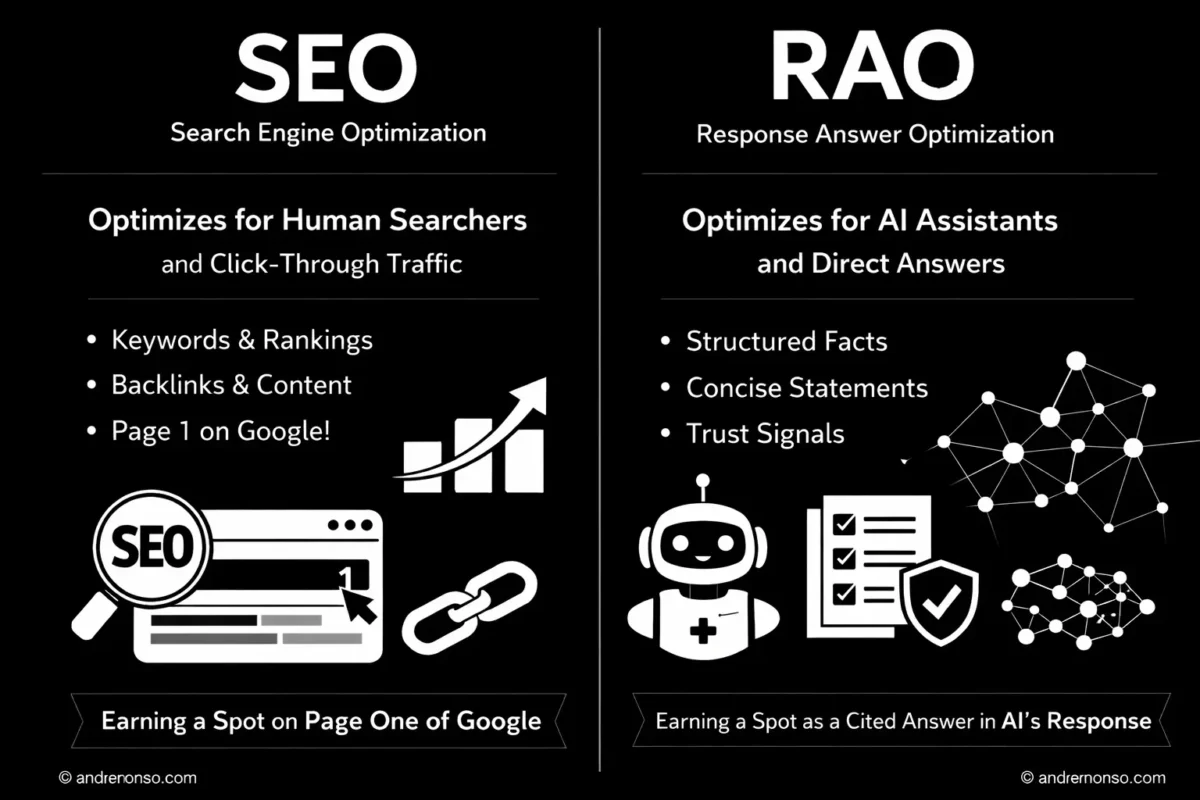
RAO vs. SEO: Goals and Differences
To appreciate why RAO is transformative, it helps to compare it with classic SEO. In the traditional model:
- Goal: Rank as high as possible in search results to attract clicks.
- Optimisation focus: Keywords, meta tags and backlinks.
- Success metric: Click‑through rate and traffic.
- End user: Human searcher.
RAO shifts these priorities:
- Goal: Become one of the trusted sources an AI uses when generating an answer.
- Optimisation focus: Contextual relevance, clear answers and structured data that AI can parse.
- Success metric: Being cited or referenced in AI answers.
- End user: The retrieval component of an AI assistant and, by extension, the user listening to or reading the answer.
This does not mean SEO is obsolete. The Business Online Mastery article stresses that SEO remains “the foundation and RAO a new layer on top”. Without indexing and basic optimisation, AI models may never encounter your content. But RAO recognises that AI systems evaluate content differently. They synthesise across multiple documents and value context-rich, factually precise passages. As the Weft Technologies article notes, RAO optimises for retrieval systems, contextual alignment and trust signals. In other words, SEO gets you visible; RAO gets you cited.
RAO Best Practices for Content and Technical Setup
So how can a professional services firm apply RAO? The following best practices summarise guidance from industry sources:
1. Answer questions directly and clearly
AI models are looking for exact answers to user questions. Therefore, structuring content so that common questions appear as headings and are immediately followed by succinct, plain‑language answers. For example, instead of burying service details in lengthy prose, use a heading like “What does our UX audit include?” and provide a direct list. Avoid rambling introductions that obscure the answer.
2. Use structured optimisation and schema
Organise your content with logical HTML headings (<h2>, <h3>) and use bullet points or tables for key facts. Schema.org markup (e.g. FAQPage, HowTo) helps AI systems identify question‑answer pairs. Structured data matches visible text and signals to search engines and AI what type of information the page contains. Consider adding dedicated FAQ sections that mirror the queries your potential clients ask.
3. Demonstrate E‑E‑A‑T
Experience, Expertise, Authoritativeness and Trustworthiness (E‑E‑A‑T) were important for SEO and are vital for RAO. The Business Online Mastery article advises clearly indicating authorship and credentials, citing sources and keeping information up to date. Google’s guidelines similarly encourage creating helpful, reliable, people‑first content. For service firms, include bylines for team members, show certifications (e.g. CPA, CPA, or “Chartered Engineer”), and reference reputable data. Credible, well‑sourced content is more likely to be selected by AI than thin or unverified claims.
4. Make content “chunkable”
AI doesn’t always read entire pages; it extracts relevant passages. Structure content into discrete sections with descriptive subheadings and keep paragraphs short. Bullet points, numbered steps and summary boxes allow AI to isolate self‑contained nuggets of information. Instead of a 1,500‑word wall of text about “digital strategy,” break it into subtopics like “Conducting a brand audit,” “User journey mapping,” and “Conversion rate optimisation” with concise definitions.
5. Monitor and refine
RAO is still evolving. The Business Online Mastery guide suggests regularly testing how AI platforms answer queries in your domain and noting whether they cite your content. Use your own questions in ChatGPT or Bing Chat to see if your site appears. Review referral traffic from AI domains (e.g. chatgpt.com) and adjust content accordingly. Continuous improvement, just as in traditional SEO, is key.
6. Align your technical SEO
Google’s AI‑features documentation stresses that there are no additional technical requirements for appearing in AI Overviews and AI Mode beyond being indexed and eligible for snippets. However, following core SEO practices remains essential: allow crawling in your robots.txt, use internal links to make content easily findable, provide good page experience and ensure that important content is available in textual form. High‑quality images and video can support textual content, but do not rely solely on multimedia—AI systems still favour text. You also do not need to create special machine‑readable files or unique markup.
Implementing RAO for Professional Services
The general principles above become particularly powerful when tailored to the needs of business owners and professional service firms. Here’s a step‑by‑step RAO roadmap:
- Audit your existing content: Identify the core questions prospective clients ask. For a management consulting firm, these might include “How can I reduce operational costs?” or “When should I outsource my HR function?” Collect questions from sales calls, emails and search queries.
- Create answer‑oriented pages: For each question, develop a dedicated section or article with the question as a heading and a succinct answer. Provide context, examples and next steps beneath the answer. Link related topics together with clear internal links.
- Add schema and structure: Implement FAQPage or HowTo schema where appropriate, and ensure your headings follow a logical hierarchy. Use bullet points to summarise frameworks or methodologies (for example, the 7‑S model in strategy consulting). Add bylines and update dates to build trust.
- Cite authoritative sources: When making claims such as quoting industry statistics or legal requirements, link to official publications or well‑regarded reports. Referencing credible sources tells both users and AI that your content is grounded in evidence.
- Integrate E‑E‑A‑T into your brand: Create an “About” page highlighting your team’s qualifications, client success stories and contributions to industry forums. Keep content updated; outdated information erodes trust. Where possible, incorporate testimonials or case studies to demonstrate real‑world impact.
- Monitor AI citations and adjust: Periodically ask AI assistants the questions your content answers and see whether your site is referenced. Use analytics to track visits from AI platforms and measure whether traffic quality improves. Google notes that clicks from AI Overviews tend to be higher quality. Use these insights to refine your content and structure.
By following these steps, professional services firms can position themselves as reliable sources in AI‑driven search. Forward‑thinking enterprises in healthcare, finance, retail and education are already using RAO techniques. For example, hospitals feed structured medical data into AI‑optimised repositories to ensure their research is cited in health queries, while banks publish RAO‑ready content to provide real‑time financial advice.
Opportunities and Challenges
RAO offers significant rewards. Early adopters enjoy first‑mover advantage, gaining AI visibility before competitors. Being referenced by AI enhances brand credibility and creates a level playing field where smaller firms can compete with larger competitors by offering precise, trustworthy insights. Integration with voice search, influencer marketing and other digital strategies can amplify returns.
However, RAO also brings challenges. As AI answers reduce click‑through traffic, success will be measured by influence and mentions rather than raw visits. Tracking AI citations is more complex than monitoring SERP rankings. Content needs to meet higher standards of factual rigour and structure. Technical barriers such as vector databases and embeddings may require new tools. Most importantly, AI systems will not reference content that lacks clear E‑E‑A‑T signals, so brands must invest in credibility.
AI‑driven search is transforming how people discover information. Being visible in this new landscape requires more than ranking for keywords—it demands that your content be retrieved, trusted and used by AI systems. RAO is the strategy that aligns your content with retrieval‑augmented generation and answer engines. By combining solid SEO fundamentals with answer‑oriented content, structured organisation, trust signals, and ongoing monitoring, professional service firms can turn AI’s evolution from a threat into an opportunity. The companies that adapt now will be the ones whose insights power the AI answers of tomorrow.